

The horse's mouth
Equine teeth are hypsodont teeth - they extend high above the gumline for better abrasion of feed. Instead of a continuous coat of enamel (as found in human teeth), equine tooth surfaces have rings and ridges of enamel surrounded by cement and dentin. These materials wear at different rates. The softer cement and dentin wear down first, leaving sharp points and ridges of the harder enamel. Horses have 2 sets of teeth: deciduous, or baby teeth, and permanent teeth. As the 24 deciduous teeth are replaced, the horse also grows additional teeth for a full set of 36-44 permanent teeth. All of these are folded to some degree.Equine teeth include:
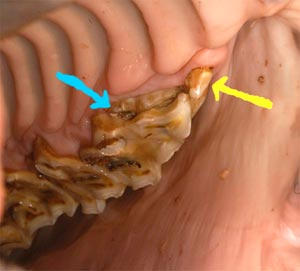
Incisors: the front teeth • less folded than molars • top fold makes up an infundibulum with a cup at the top • curved • separated from the molars by the bar or interdental space, an area with no teeth (where the bit rests) • young horses have 12 incisors Molars: the grinding teeth • extend along both sides of the upper and lower jaw behind the bar • lower molars are narrower than upper molars • lower molars usually have 2 roots • upper molars have 3 or 4 roots Premolars: deciduous grinding teeth • present in young horses • there are 12 premolars Canine teeth: permanent teeth • erupt at 4-5 years of age in male horses • only 20-25% of females have canines • occur behind incisors in the bar Wolf teeth: rudimentary premolar teeth • erupt in front of the molars • considered permanent since they aren't shed • not all horses get wolf teeth • serve no purpose in the modern horse • usually removed to avoid problems with the bit • blind (unerupted) wolf teeth usually removed to prevent gum problems, pain Caps/cap fragments: unshed fragments of deciduous teeth • prevent normal eruption of permanent teeth • must be removed to allow for normal dental development
© Copyright © 2002- 2016 All rights reserved


Northeast Texas Veterinary Dental Center
8414 Wesley Street Greenville, TX 75402 903-454-1563 info@crossroadsvetclinic.com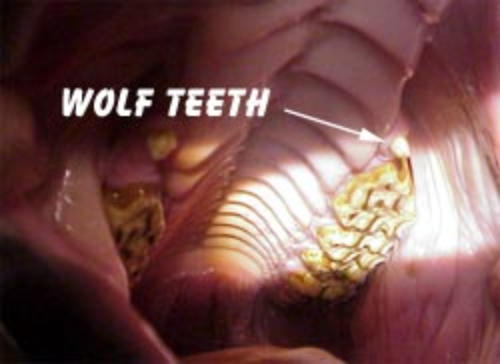
















© Copyright © 2002- 2016 All rights reserved This page designed and
maintained by Word Works
The horse's
mouth
Equine teeth are hypsodont teeth - they extend high above the gumline for better abrasion of feed. Instead of a continuous coat of enamel (as found in human teeth), equine tooth surfaces have rings and ridges of enamel surrounded by cement and dentin. These materials wear at different rates. The softer cement and dentin wear down first, leaving sharp points and ridges of the harder enamel. Horses have 2 sets of teeth: deciduous, or baby teeth, and permanent teeth. As the 24 deciduous teeth are replaced, the horse also grows additional teeth for a full set of 36-44 permanent teeth. All of these are folded to some degree.Equine teeth include:
Incisors: the front teeth • less folded than molars • top fold makes up an infundibulum with a cup at the top • curved • separated from the molars by the bar or interdental space, an area with no teeth (where the bit rests) • young horses have 12 incisors Molars: the grinding teeth • extend along both sides of the upper and lower jaw behind the bar • lower molars are narrower than upper molars • lower molars usually have 2 roots • upper molars have 3 or 4 roots Premolars: deciduous grinding teeth • present in young horses • there are 12 premolars Canine teeth: permanent teeth • erupt at 4-5 years of age in male horses • only 20-25% of females have canines • occur behind incisors in the bar Wolf teeth: rudimentary premolar teeth • erupt in front of the molars • considered permanent since they aren't shed • not all horses get wolf teeth • serve no purpose in the modern horse • usually removed to avoid problems with the bit • blind (unerupted) wolf teeth usually removed to prevent gum problems, pain Caps/cap fragments: unshed fragments of deciduous teeth • prevent normal eruption of permanent teeth • must be removed to allow for normal dental development